Accessibility is specific to the traveler and can change with construction, weather, equipment, and maintenance. Use this page as a planning checklist, not as an accessibility certification. Confirm the details that matter directly with each operator shortly before visiting.
Verified planning leads
| Place or service | What the official source establishes | What to confirm for your trip |
|---|---|---|
| BATA accommodations | BATA’s current official confirmation is that all Link buses and most Loop buses are wheelchair accessible. | The exact route, stop, lift availability, mobility-device fit, and current reduced-fare eligibility. |
| Elk Rapids Rotary Park launch | Paddle Antrim, an association and project partner, reports that the universally accessible kayak launch opened with a ribbon cutting on June 3, 2026. The Village park page also lists Rotary Park’s kayak launch. | Current launch condition, transfer features, parking path, water level, and whether assistance is needed. The opening report does not guarantee that every feature will meet every paddler’s needs. |
| TART Trails | TART publishes current trail maps and individual trail information. | Surface, grade, closure, crossing, restroom, and parking details for the exact segment. |
| Sleeping Bear Dunes National Lakeshore | NPS maintains an accessibility page for visitor facilities, trails, overlooks, and beach-access planning. | Current construction, seasonal equipment, accessible parking, and which route meets your needs. |
| Dennos Museum Center | The museum publishes its accessibility information and accommodation contact. | Current exhibition access, seating, sensory needs, and any requested accommodation. |
| Cherry Capital Airport | The airport publishes terminal, airline, parking, and traveler information. | Wheelchair assistance with the airline, pickup procedure, accessible parking, and construction impacts. |
Verified July 27, 2026. “Accessible” does not mean every feature works for every visitor. A paved route may still include slopes, crossings, gaps, sand, snow, or a missing accessible restroom.
Build a dependable plan
- Choose the exact entrance, stop, trail segment, or facility—not just the general destination.
- Ask about the full route from parking or transit to the activity, including surfaces, grades, doors, elevators, restrooms, and seating.
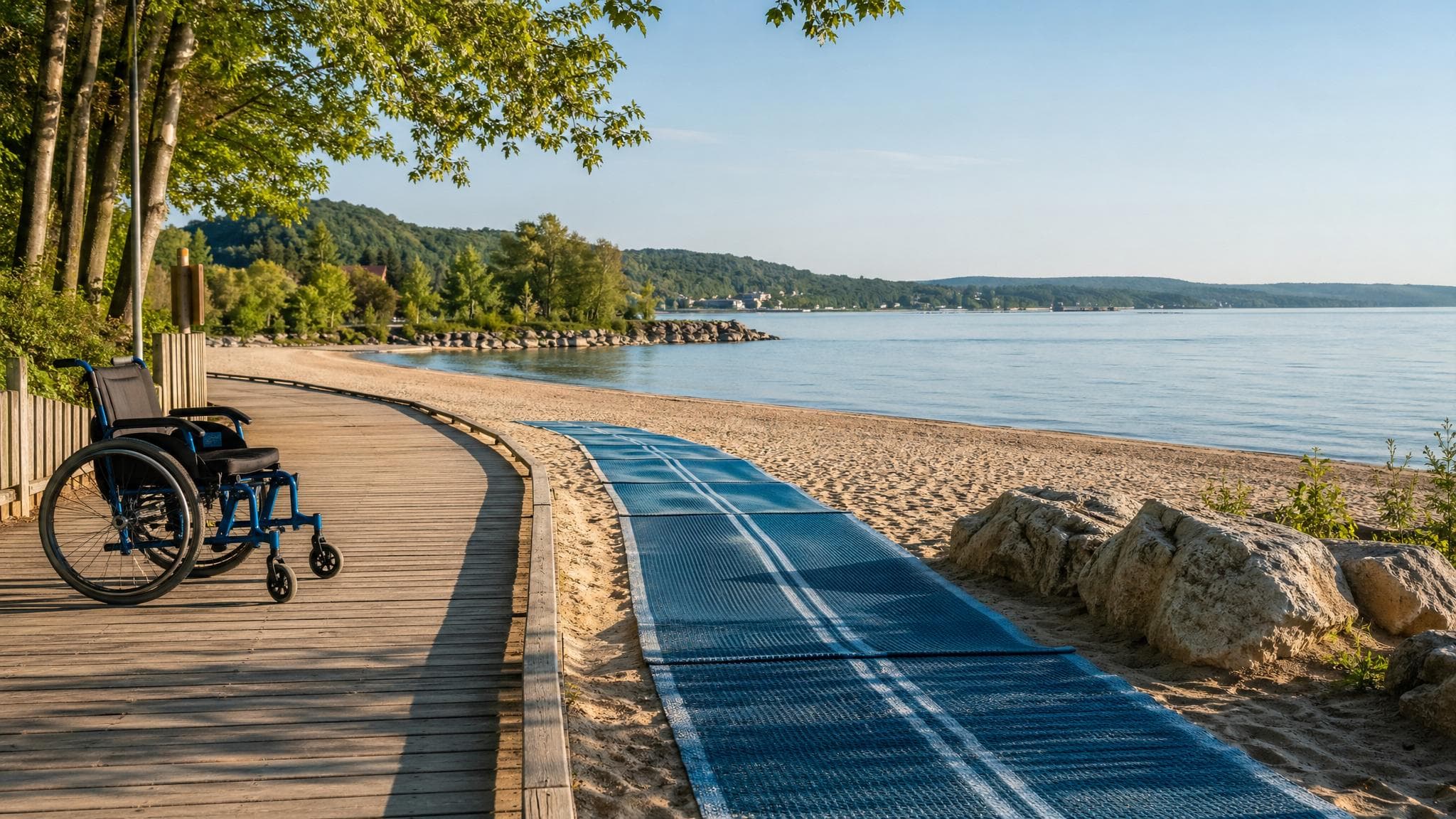
- Confirm whether beach mats, adaptive launches, loaner equipment, or assistance are installed and available on your date.
- Save a backup activity. Shoreline conditions, construction, and equipment outages can change access quickly.
- For transit, check the specific BATA route and stop; do not assume the “most Loop buses” qualification applies to every vehicle or trip.
Water and beach access
An adaptive launch does not remove water risk. Check weather and water conditions, wear a properly fitted life jacket, and use assistance appropriate to the paddler. For beaches, confirm the path beyond the parking area: a paved approach may end before sand or water.
For federal park sites, start with the NPS accessibility page and current conditions. For city or village parks, contact the named municipality rather than relying on an old roundup.
Questions worth asking
- Is the designated accessible entrance the same as the main entrance?
- Is the full route step-free, and what is its surface and slope?
- Are accessible restrooms open on the visit date?
- Is adaptive equipment installed, and does it require a reservation or staff help?
- Are service animals accommodated under the applicable rules?
- Is there a quieter arrival time or sensory accommodation?
Direct confirmation is the safest final step. Official pages above are the source of record and should be checked again if your trip is later than this guide’s verification date.